Run this audit before reading further: list every tool your agency pays for to deliver local SEO — rank tracking, GBP management, review monitoring, reporting, audits, the spreadsheet that glues them together. Now mark the ones your team actually opens weekly, and circle the ones whose numbers you'd defend in front of a client without checking somewhere else first. For most agencies in 2026 the list runs six to nine tools, the weekly-open set is about half, and the circle is nearly empty. You're paying for a stack you don't trust.
Two things changed the calculus this year. First, local search stopped being one surface: clients now ask whether they show up in Google's AI Overviews, in AI Mode, in ChatGPT's recommendations — and a stack built to answer "what's my rank?" can't answer "does the machine recommend us?" Second, tool sprawl became a margin problem. Per-location and per-scan pricing means the stack punishes exactly the thing your agency is trying to do: grow.
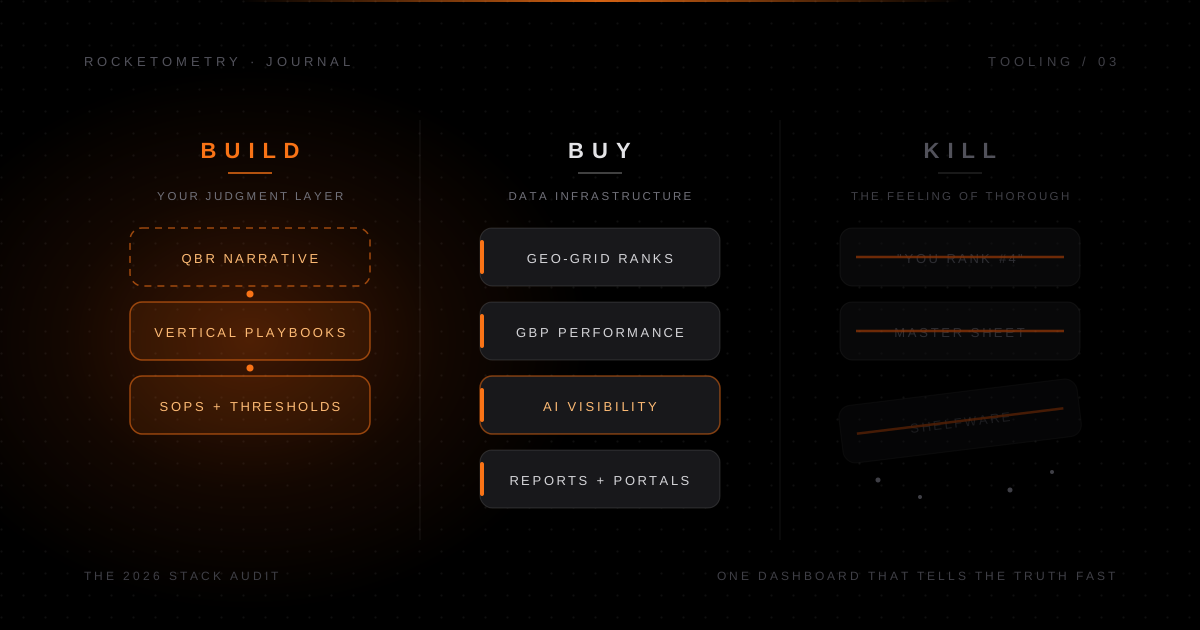
The way out is an old engineering discipline applied to agency ops: sort every capability into build, buy, or kill.
Kill: the line items that earn nothing
The single-number rank tracker
Any tool whose core deliverable is "you rank #4" is reporting a fiction in local. Position varies block by block; owners check from their own driveway; a single averaged number is one client screenshot away from undermining your whole report. If your tracker can't show rank as a geographic surface, it isn't measuring the thing your clients sell from.
Manual reporting — the tool called "someone's Tuesday"
The most expensive item in most stacks doesn't appear on an invoice: hours of account-manager time screenshotting dashboards into slides. It's slow, error-prone, and it consumes your most client-fluent people. If a report requires a human to assemble data, the report is a cost center. Kill the process, not the person — reassign those hours to strategy and saves.
Per-scan and per-location pricing
Watch for tools where the bill scales linearly with your client count. That pricing model converts your growth into your vendor's growth and quietly caps how often you're willing to measure. If you're rationing scans to control costs, the pricing has already changed your service quality. Consolidate toward per-agency pricing where measuring more costs nothing.
The master spreadsheet
It survives because it's where everything finally coexists. But it's unaudited, unowned after the author leaves, and wrong in ways you find out about from clients. Once a real single source of truth exists, the spreadsheet must actually die — a "backup" sheet that still gets updated is a second reporting system with none of the guarantees.
Shelfware with a login
The audit-generator you bought for sales in 2024. The social scheduler nobody opened since March. The rule is unsentimental: no weekly opens and no client-facing output for 60 days — cancel it this quarter.
Buy: data is infrastructure, not differentiation
The buy column is everything where correctness matters, freshness matters, and building it yourself is a full-time engineering job wearing a costume of a weekend project:
- Geo-grid rank data — 5×5 to 11×11 grids per location, on schedule, with competitor overlays. This is scraping infrastructure at scale; you do not want to own it.
- GBP performance data — calls, direction requests, website clicks, photo views, with daily granularity and history. Comes from data partnerships you can't negotiate one agency at a time.
- AI visibility monitoring — share of voice across AI Overviews, AI Mode, ChatGPT, Gemini, and Claude for the questions real customers ask, with citation tracking. In 2026 this is the fastest-growing client question and the least answerable with a legacy stack.
- Report generation and client portals — white-label, scheduled, self-serve. Every portal session is a status meeting you didn't attend.
Four buying criteria separate agency-grade tools from prosumer ones: multi-client by default (a client switcher bolted onto a single-business tool always shows its seams), white-label depth (your brand on reports and portals, not just a logo on a PDF), pricing that scales sub-linearly with clients, and an export path — your data should never be hostage to a renewal negotiation.
And bias hard toward consolidation. Every integration between two point tools is a seam, and seams are where numbers stop matching. When the rank data, GBP data, and AI visibility live in one system, "which number is right?" stops being a weekly conversation.
Build: the layer no vendor can sell you
Here's what the build column is not: dashboards, scrapers, PDF generators. Agencies that build data infrastructure are doing unpaid software development with worse uptime than the vendors they replaced.
What you actually build is the judgment layer that sits on top of bought data:
- Vertical playbooks — what "good" looks like for a med spa vs. an HVAC company: keyword templates, grid sizes, review-velocity targets, GBP cadences. This is codified experience; it's your moat.
- The narrative — the quarterly story that turns a grid delta into "here's why your north-side coverage matters and what we're attacking next." No tool writes this, and it's the part clients renew for.
- Your SOPs and intervention thresholds — at what health-score drop does a strategist get pulled in, what the save play is, who calls the client. Process is a product you build once and sell to every retainer.
- Light glue automation — a webhook that posts red-flag alerts into your project tool. Glue, yes. Infrastructure, no.
The one-dashboard test
Score your stack with a single question: when a client calls and asks "how are we doing?", how many tabs does the true answer require? One tab means you have a stack. Four tabs means you have a scavenger hunt with a monthly invoice. Every tab past the first adds minutes to every client question, a seam where numbers disagree, and a login your team will eventually stop checking.
The math on consolidation is rarely close. Stack sprawl costs the sum of subscriptions plus the swivel-chair hours plus the trust discount on numbers nobody can reconcile. Agencies that run this audit honestly usually find they can cut spend by a third while measuring more — because they stop paying for overlap and start paying for one system of record.
The stack is a strategy statement
Build, buy, kill isn't a procurement exercise; it's a declaration of what your agency believes it's for. Buy the measurement, because measurement is a commodity done well by people who do only that. Build the judgment, because judgment is the only thing on your invoice a client can't get cheaper elsewhere. And kill everything whose main output is the feeling of being thorough. In 2026, the agencies winning local aren't the ones with the most tools — they're the ones whose one dashboard tells the truth fast.