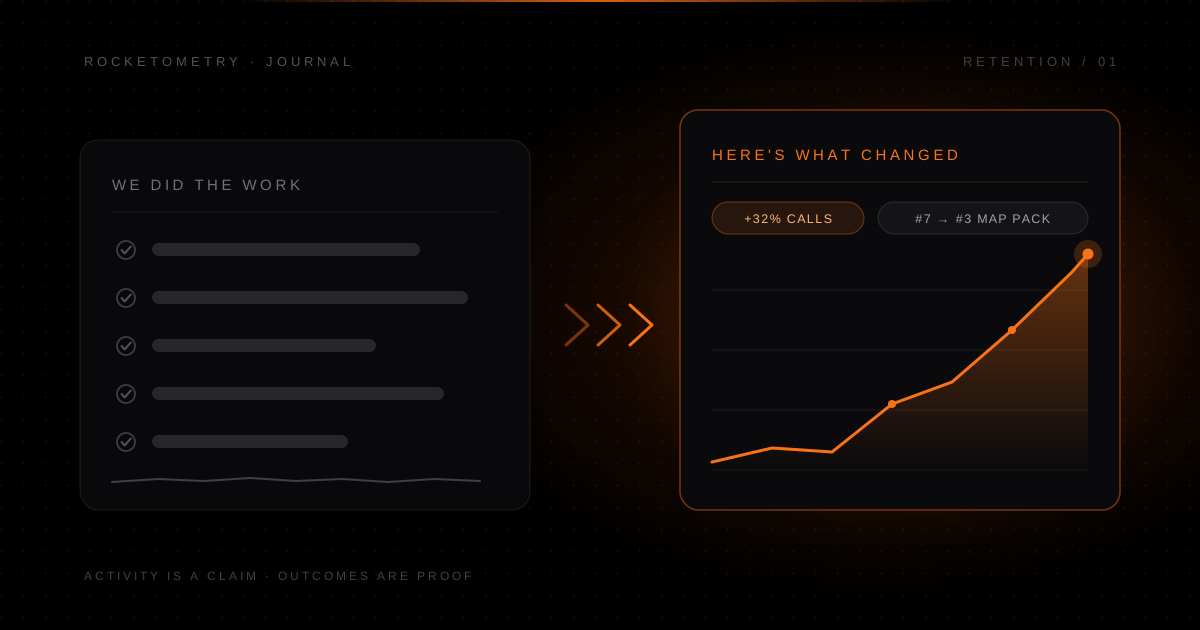
Clients almost never fire agencies for bad work. They fire them for invisible work. Ask any agency owner to do a post-mortem on their last five lost local SEO retainers and a pattern shows up fast: the rankings were usually fine. The reviews were coming in. The Business Profile was optimized, the citations were clean, the posts went out on schedule. The work happened. What didn't happen was the client seeing it happen — or more precisely, seeing what it changed.
That's the reporting gap: the distance between "we did the work" and "here's what changed because of it." Most local SEO churn lives inside that gap, and most agencies are unknowingly widening it every month with the very reports they think are protecting the relationship.
Activity reports are churn machines
The standard agency deliverable is an activity report. Tasks completed, posts published, citations built, keywords tracked, hours logged. It feels safe — it proves effort. But from the client's side of the table, an activity report does something subtly corrosive: it prices the relationship in units of labor instead of units of outcome.
Once a client is evaluating you on labor, you've entered a game you can't win. Labor is comparable. A cheaper agency, a freelancer, an in-house hire, an AI tool — all of them can plausibly claim to do "the same tasks." Outcomes are the only thing that isn't commoditized, and an activity report never mentions them.
The month a client starts asking "so what exactly are we paying for?" is rarely the month the work stopped working. It's the month the report stopped answering the question.
Why the usual local SEO report fails
Even agencies that try to report outcomes usually reach for artifacts that don't survive contact with a skeptical owner. Three failure modes come up constantly:
1. Average rank is a lie in local
Local rankings aren't a number — they're a surface. The same dentist can be #2 from the office parking lot and #14 four blocks north. Reporting "you rank #5 for emergency dentist" flattens that surface into a single figure the client can disprove from their own driveway, and the moment they do, every other number in your report becomes suspect. Geo-grid data — a 5×5 or 7×7 map of positions across the actual service area — is the only rank format that matches how customers actually search and how owners actually check.
2. Screenshots without deltas
A screenshot of the Business Profile insights panel says "here is a graph." It doesn't say "calls are up 32% since we rewrote your services and added the new photo set." Data without a delta and an attribution isn't evidence of your work; it's weather. Clients don't renew for weather.
3. The monthly PDF that arrives too late to matter
A report assembled by hand in the first week of the month describes a world that's already three to five weeks old. If a competitor overtook the map pack on the 9th and your client hears about it from you on the 4th of the following month, you didn't report — you confessed. Cadence is part of credibility.
What "here's what changed" reporting looks like
Closing the gap doesn't mean prettier PDFs. It means restructuring the report around three questions, in this order, every single time:
- What changed? — in the client's units, not yours. Calls, direction requests, website clicks, review velocity, map-pack coverage across their territory. "Search visibility improved" is your unit. "Eleven more calls a week" is theirs.
- Why did it change? — the causal line from your work to the movement. This is where work annotations earn their keep: when the geo-grid jumps two positions across the north side of town, the report should show the timeline marker for the landing page you shipped two weeks earlier. Without annotations, your wins look like luck. With them, they look like invoices worth paying.
- What are we doing next? — the open loop that makes the next report an anticipated event instead of an administrative one. A client who knows what you're attacking this month has a reason to open next month's email.
Competitor context multiplies all three. "You moved from #7 to #3" is good. "You moved from #7 to #3 while Hillside Dental slipped to #6" is retention-grade, because it reframes the retainer from a cost line into a competitive weapon. Local is zero-sum; your reporting should read like it.
The two-minute rule
Here's a test worth running on your current report template: hand it to someone outside the industry and time how long it takes them to find the single best thing that happened last month. If it's over two minutes, the report has failed — because that's roughly the attention a busy owner gives it before forwarding it to a folder they never reopen.
The fix is editorial, not analytical. Lead with the headline win in plain language. Put the geo-grid before-and-after side by side. Keep one screen of numbers that matter and push everything else to an appendix or a live dashboard link. Your report is not a data export; it's the argument for your own renewal, delivered monthly.
Cadence: a weekly signal beats a monthly novel
The agencies with the stickiest local SEO retainers have quietly moved from "the monthly report" to a two-layer rhythm:
- A short weekly or biweekly signal — automated, three to five numbers with deltas, one sentence of commentary. It costs you nothing when the pipeline is automated, and it means the client never goes a fortnight without evidence you exist.
- A monthly narrative — the what-changed / why / what's-next story, with competitor context and annotated wins. This is the strategic touch that justifies the retainer tier.
The trap is trying to run that rhythm by hand. If an account manager spends four hours a month per client screenshotting dashboards and pasting charts into slides, the math stops working somewhere around client fifteen — and the quality collapses long before the math does. Reporting has to be a pipeline, not a chore: data collected continuously, work annotated as it ships, reports assembled and sent automatically under your brand.
The gap is the product
Local SEO agencies like to believe retention is won in the work. It's actually won in the translation of the work. The agencies that grow are rarely the ones doing the most sophisticated optimization — they're the ones whose clients can repeat, in their own words, what changed last quarter and why the agency caused it.
"We did the work" is a claim. "Here's what changed" is proof. Every month, your report picks one of those sentences on your behalf. Choose deliberately.